
Longarm Room Size Calculator: How Much Space a Quilting Frame Needs
How big a room a longarm quilting frame needs, from Handi Quilter's own room diagrams: frame footprint plus walking space, with a calculator to check your room.
Affiliate disclosure: product links on this page go to Amazon, or to the maker's own store for brands that sell only direct. As an Amazon Associate we earn from qualifying purchases, at no extra cost to you; a link to a maker's store earns us nothing. No retailer or brand sees our picks before they are published or has any say in them. How we choose.
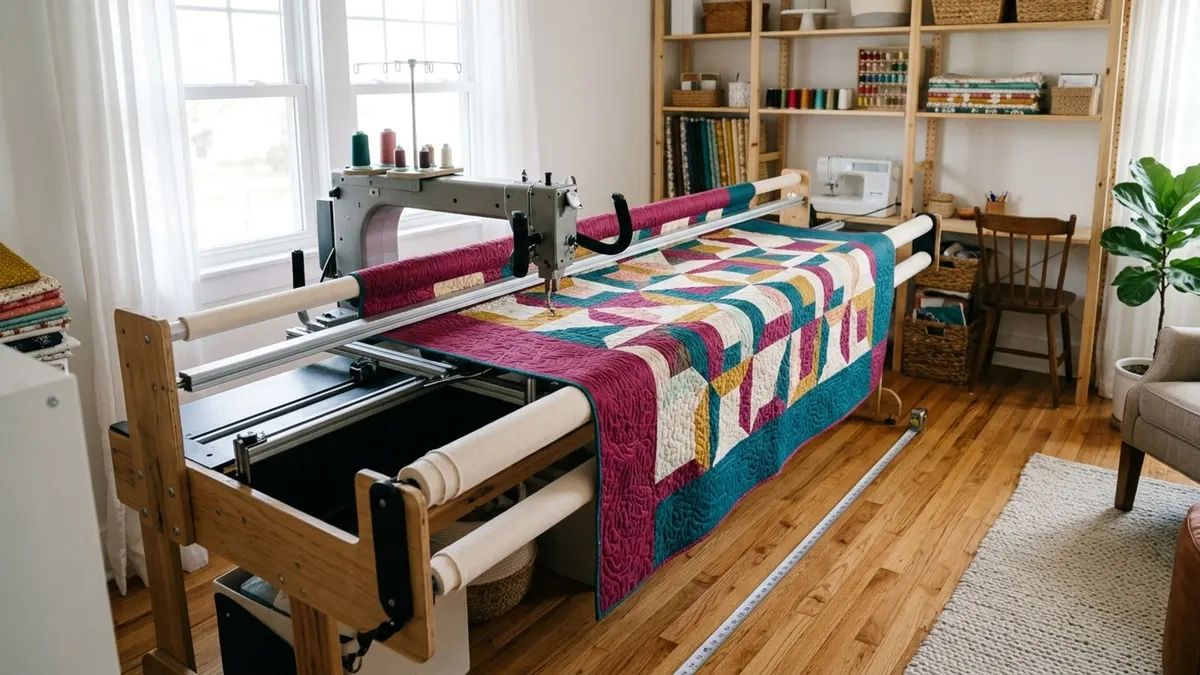
A longarm on a frame needs the frame's own footprint plus room to walk around it as you quilt and advance the quilt. Handi Quilter's room diagrams put that walking space at about 2 feet at each open end and 2.5 feet added front to back: its 8-foot Loft frame, 4.5 feet deep, needs a room about 12 feet by 7 feet, or 10 feet long if one end sits against a wall.
Pick a frame below, or enter your own frame's size, and add your room's measurements to check the fit.
How much room does your longarm need?
Handi Quilter gives the 8 ft Loft frame and machine as 4.5 by 8 ft.
Optional
Optional
Room needed
12 ft x 7 ft
3.66 m x 2.13 m
Frame and machine
8 ft x 4 ft 6 in
Footprint before walking space
Your room
Enter your room
Add the room's width and depth to check the fit.
Walking space follows Handi Quilter's published room diagrams: 2 ft at each open end of the frame, and 2.5 ft added front to back (a 4.5 ft deep Loft frame in a 7 ft deep room). Leave more if you want shelving, a chair or a door that swings into the room.
Room sizes from the maker's diagrams
Handi Quilter publishes the footprint of each of its frames with the machine on it and draws the walking space around it. These are its figures:
| Frame | Frame and machine | Room needed | With one end on a wall |
|---|---|---|---|
| HQ Little Foot (5 ft) | 4 by 5 ft | 8 to 10 ft by 6 to 8 ft | About 6.5 to 8 ft long |
| HQ Loft (8 ft) | 4.5 by 8 ft | About 12 ft by 7 ft | About 10 ft long |
| HQ Loft (10 ft, with 2 ft extension) | 4.5 by 10 ft | About 14 ft by 7 ft | About 12 ft long |
| HQ Studio3 (10 or 12 ft) | Not given in text | Frame plus walking space | Saves 2 ft of length |
| HQ Gallery2 (10, 12 or 14 ft) | Not given in text | Frame plus walking space | Saves 2 ft of length |
The calculator uses the same rule for any frame: 2 feet at each open end and 2.5 feet added front to back. For a frame not listed, take the overall length and depth with the machine on it from the frame's manual.
How frame length relates to quilt size
A longer frame quilts a wider quilt in one pass. Handi Quilter says its 10-foot Studio3 frame allows 108 inches of quilting width and the 12-foot frame up to 132 inches. Grace gives its 8-foot Q-Zone Queen frame a maximum quilt area of 82 inches in the queen setting and 32.5 inches in the crib setting, and notes that the figure can vary slightly with the machine.
Small frames trade width for space. Handi Quilter's 5-foot Little Foot frame has a 14 by 48 inch quilting space; you baste the quilt and lay it over the frame, and its Little Buddy attachment lets you load and roll quilts up to 48 inches wide without basting.
No room for a frame? Sit-down longarms
A sit-down (stationary) longarm stays still while you move the quilt under the needle, so it needs only a table and a chair. Handi Quilter's Moxie ST and Amara ST sit on a table 38 by 38 inches, and each optional table extension adds 18 inches of width (two add 36 inches) to support bigger quilts. Our sit-down longarm guide compares them.
Tips before you buy
- Measure the room, not the floor plan. Radiators, doors that swing in and furniture you will keep all take space.
- Think about casters. Handi Quilter sells optional casters for all its frames and tables, so a frame can be pushed aside when the room has another use.
- Automation does not change the footprint. Handi Quilter says adding its Pro-Stitcher computerized system to a movable machine does not change the space required.
- Ask a dealer. Handi Quilter suggests talking to a retailer if your space is tight; dealers can often show a frame set up.
For machines to put on the frame, see our best longarm quilting machine guide.
Frequently asked questions
How much space do I need for a longarm quilting machine?
For an 8-foot frame, about 12 by 7 feet, per Handi Quilter's diagram for its 4.5 by 8 foot Loft frame. With one end against a wall, about 10 feet of length is enough.
Can I put a longarm frame against a wall?
One short end, yes. Handi Quilter says putting one end of the frame against a wall saves about 2 feet of length. You still need walking space along the front and back to advance the quilt.
What size longarm frame do I need for a king quilt?
One whose quilting width is at least the quilt's width. Handi Quilter's 10-foot Studio3 frame allows 108 inches of quilting width and its 12-foot frame up to 132 inches.
What if I have no room for a frame?
Look at a small frame like Handi Quilter's 5-foot Little Foot, which needs about 8 to 10 by 6 to 8 feet, or a sit-down longarm on a 38 by 38 inch table plus room for a chair.
Sources
- How Much Space Do I Need For My New Longarm?, Handi Quilter
- How Much Space Does the Moxie Need?, Handi Quilter
- The Q-Zone Queen, The Grace Company
Cover image: Illustration: CraftsCall (AI-generated)
Related guides
Best Longarm Quilting Machines for a Quilting Business (2026)
Five frame longarms from a 13-inch hybrid to a 19-inch Elite, with the throat size, stitch speed and frame each needs, from the makers' own specs.
Best Sewing Machines for Quilting: Piecing and Free-Motion (2026)
Five domestic machines for piecing and quilting, from a 70-stitch budget Brother to Janome's AcuFeed Flex Skyline, with what each brings to a quilt.
Best Sit-Down Longarm Quilting Machines (2026)
Five stationary quilting machines for small studios: throat size, stitch regulation, table size and the makers' prices.