
Serger vs Coverstitch vs Sewing Machine: Which Does Which Job
Serger, coverstitch machine and sewing machine compared: what each sews, which jobs need which machine, and the order to buy them in for a sewing business.
Affiliate disclosure: product links on this page go to Amazon, or to the maker's own store for brands that sell only direct. As an Amazon Associate we earn from qualifying purchases, at no extra cost to you; a link to a maker's store earns us nothing. No retailer or brand sees our picks before they are published or has any say in them. How we choose.
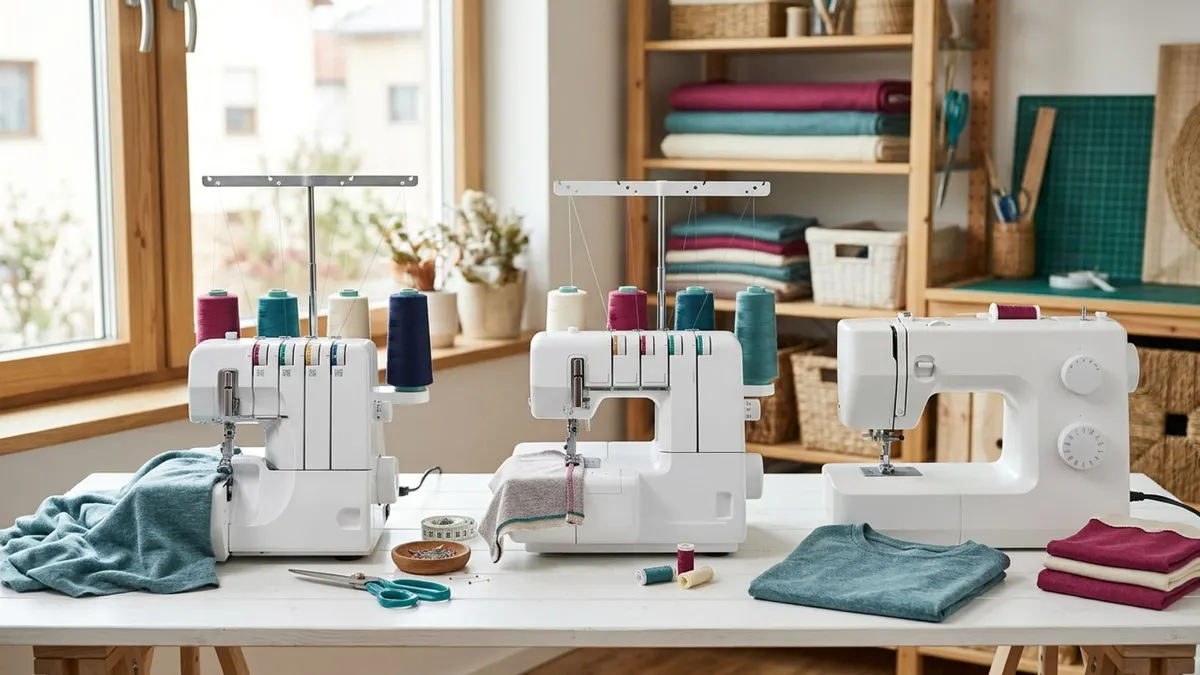
A sewing machine sews almost everything: seams, zippers, buttonholes, topstitching and quilting. A serger trims and finishes edges and sews stretchy seams in one pass. A coverstitch machine sews the stretchy two- or three-row hem on T-shirts and leggings. Buy a sewing machine first, add a serger when you sew knits or want finished inside seams, and add a coverstitch machine when ready-to-wear hems on knits are part of what you sell.
The comparison below uses the makers' own descriptions: Brother, Janome, Juki and Baby Lock.
The three machines at a glance
| Sewing machine | Serger | Coverstitch machine | |
|---|---|---|---|
| Main job | Seams, zippers, buttonholes, topstitching, quilting | Seams and edge finishing on knits and wovens | Hems and topstitching on knits |
| Threads | 2 (needle and bobbin) | 2 to 4 (up to 5 on some) | 2 to 4 |
| Trims the edge | No | Yes, with a knife | No |
| Stretch | With stretch or zigzag stitches | Yes | Yes |
| Buttonholes, zippers | Yes | No | No |
| Example | Brother ST150HDH | Brother 1034D | Brother 2340CV |
Sewing machine: the one you cannot skip
A sewing machine sews with a needle thread and a bobbin thread, so it can sew anywhere on the fabric, not only at an edge. That is why it handles the jobs the other two cannot: buttonholes, zippers, topstitching, appliqué and quilting. Brother's ST150HDH, for example, has 50 stitches including five one-step buttonholes, and comes with walking, zipper, overcasting, blind stitch and buttonhole feet.
It can sew knits too. Many machines have stretch stitches (Singer's 4552 listing includes them), and Brother packs ballpoint needles for knits and stretch fabrics with the ST150HDH. What it cannot do is trim and wrap an edge in the same pass, or sew a looper-backed hem. For thick fabrics, see our heavy-duty sewing machine guide.
Serger: seams and edges in one pass
A serger uses a knife to trim the fabric just ahead of the needles while loopers wrap thread over the edge. The result is a finished, stretchy seam in one pass, like the seams inside ready-made T-shirts. Brother's 1034D sews 4-thread and 3-thread overlock, narrow hem, rolled hem and ribbon lock stitches; Juki's 2/3/4 thread sergers add 2-thread stitches. Baby Lock describes 4-thread overlock as a strong finishing stitch.
For a knitwear line (T-shirts, leggings, baby clothes, activewear) a serger saves time on every seam. It also finishes the raw edges of woven fabric before a sewing machine seam. It cannot sew buttonholes, zippers or topstitching. Our best serger guide compares machines, and the air threading guide covers sergers that thread their loopers with air.
Coverstitch machine: the stretchy hem
A coverstitch machine does not trim the edge. It sews two or three parallel rows of needle stitches on top while a looper forms a chain underneath, so the hem stretches with the knit. Janome's CoverPro machines sew a 1-needle chain stitch, a 2-needle cover stitch (3 mm narrow or 6 mm standard) and a 3-needle triple cover stitch; Brother's 2340CV sews tri-cover, wide and narrow cover stitches from 3 to 6 mm, and chain stitch.
It does one job, but it is the job that makes a knit garment look shop-bought: the hem on sleeves, bottoms and necklines. A free arm, as on the Janome CoverPro models and Brother's CV3550, lets you hem those small tubes in the round. Our coverstitch machine guide compares the options.
Combination machines
Some machines serge and coverstitch. Juki's MO-735 is a 2/3/4/5 thread overlock with chainstitch and coverstitch, and Baby Lock's Triumph and Splendor are 8-thread overlock and coverstitch machines. A combination machine saves space and one purchase. Two separate machines can each stay threaded and set up for their own job, which saves changeover time when you sew in batches.
Which jobs need which machine
| Job | Machine |
|---|---|
| Side seams on a T-shirt | Serger (or a sewing machine stretch stitch) |
| T-shirt sleeve and bottom hems | Coverstitch machine |
| Zipper on a pouch or bag | Sewing machine |
| Buttonholes on a shirt | Sewing machine |
| Finishing raw edges on woven fabric | Serger |
| Rolled hem on a scarf | Serger with rolled hem |
| Quilting and piecing | Sewing machine |
| Canvas tote straps | Heavy-duty sewing machine |
What a three-machine setup costs
At the makers' own list prices, a full knitwear setup does not have to cost more than one premium machine. Prices change and dealers discount, so treat these as a starting point.
| Machine | Entry pick (maker's price) | Step-up pick (maker's price) |
|---|---|---|
| Sewing machine | Brother ST150HDH, $339.99 list | Janome HD-3000 Black Edition, $599 MSRP |
| Serger | Brother 1034D, $319.99 list | Brother AIR1800 (air threading), $899.99 list |
| Coverstitch | Brother 2340CV, $579.99 list | Janome CoverPro 2000CPX, $1,099 MSRP |
| Total | $1,239.97 | $2,597.99 |
For comparison, Juki's suggested retail price for the MO-1000 air threading serger alone is $2,299. Spending more buys conveniences (air threading, a free arm on the coverstitch, more stitches) rather than different kinds of seam.
The order to buy them in
- A sewing machine. Every product needs one. A machine with a walking foot and buttonholes, like the Brother ST150HDH, covers most small-shop work.
- A serger, once you sew knits regularly or want finished inside seams. The Brother 1034D has a Brother list price of $319.99.
- A coverstitch machine, when you sell knit garments and want ready-to-wear hems. The Brother 2340CV has a Brother list price of $579.99.
If your products are bags, quilts or home goods rather than knitwear, you may never need the coverstitch machine; a heavy-duty or quilting sewing machine is the better second purchase.
Frequently asked questions
Can a serger replace a sewing machine?
No. A serger sews at the fabric edge, trimming as it goes, so it cannot sew buttonholes, zippers, topstitching or quilting. Start with a sewing machine and add a serger for knits and finished seams.
Can a serger do a coverstitch?
A standard serger cannot. The cover hem needs needles on top and a looper below with no knife. Combination machines such as Juki's MO-735 and Baby Lock's Triumph and Splendor do both serging and coverstitch.
Do I need a serger to sew knits?
Not strictly. A sewing machine with stretch stitches and a ballpoint needle can sew knits; Brother packs ballpoint needles for knits with its ST150HDH. A serger is faster and finishes the edge in the same pass.
Which should I buy first, a serger or a coverstitch machine?
A serger, because it sews the seams of most knit garments. Add a coverstitch machine when you want the two-row stretchy hem that ready-made T-shirts and leggings have.
Is a combination serger and coverstitch machine worth it?
It saves space and buys one machine instead of two. The trade-off is converting between modes; two separate machines can each stay set up for their own job.
Sources
- Brother 1034D Serger, Brother USA
- Brother 2340CV Coverstitch, Brother USA
- Brother ST150HDH Strong & Tough, Brother USA
- CoverPro 2000CPX, Janome America
- Serger sewing machines, JUKI America
- Serger FAQ: the basics, Baby Lock
- Brother AIR1800 Air Serger, Brother USA
- HD-3000 Black Edition, Janome America
- MO-1000 serger, JUKI America
Cover image: Illustration: CraftsCall (AI-generated)
Related guides
Best Air Threading Sergers: Brother, Juki and Baby Lock Compared (2026)
Four sergers that thread their loopers with air, how each maker's system works, and when air threading is worth paying for.
Best Coverstitch Machines for Hemming Knits (2026)
Four coverstitch machines for the stretchy, ready-to-wear hem on T-shirts and leggings, with what chain, cover and triple cover stitches each sew.
Best Heavy-Duty Sewing Machines for Bags, Denim and Canvas (2026)
Five heavy-duty sewing machines for totes, aprons, denim and canvas, and what actually makes a home machine heavy duty.