
Clamshell vs Swing-Away vs Draw Heat Press: Which Style to Buy
Clamshell, swing-away, draw and auto-open heat presses compared: workspace, burn risk, layout, thick items and speed, with the makers' own trade-offs and picks.
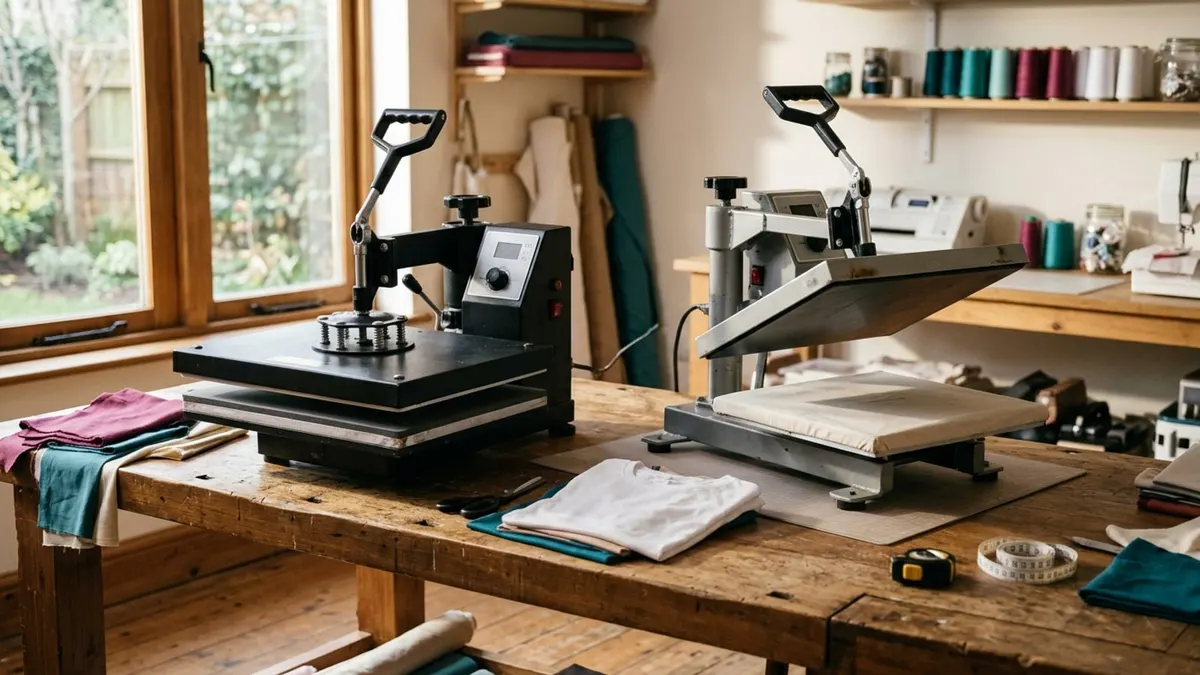
Affiliate disclosure: product links on this page go to Amazon, or to the maker's own store for brands that sell only direct. As an Amazon Associate we earn from qualifying purchases, at no extra cost to you; a link to a maker's store earns us nothing. No retailer or brand sees our picks before they are published or has any say in them. How we choose.
Buy a clamshell if space is tight and most of your work is straightforward shirts; buy a swing-away if you lay out multi-piece or layered designs, press thick items, or want no hot plate over your hands; consider a draw press if you want a cool workspace in a smaller footprint and your designs are simple. Auto-open clamshells, like the Cricut AutoPress 2, remove the main reason beginners burn or over-press, which is why they have become the default first press for many home businesses.
The differences below come from the press makers' own descriptions, chiefly Hotronix (Stahls' heat press brand), which makes all three styles, and the manuals of the presses we recommend.
The four styles at a glance
| Style | How it opens | Workspace | Main advantage | Main drawback |
|---|---|---|---|---|
| Clamshell | Upper plate hinges up like a book | Least | Compact, one-step operation | You work beneath the hot plate |
| Swing-away | Upper plate lifts and rotates to the side | Most | Heat-free layout with full access | Needs room for the swing; more steps |
| Draw | Lower platen slides out like a drawer | Medium | Heat-free layout, space-saving | The moving platen can shift intricate layouts |
| Auto-open | Opens itself when the timer ends | Varies | No over-pressing if you step away | Costs more than a manual press of the same size |
Clamshell
Hotronix describes the clamshell as offering simple one-step operation, portability and the smallest workspace. Stahls' buying guide gives the trade-off plainly: working beneath the hot platen can be uncomfortable and may increase the risk of burns. In practice, a clamshell is quick for a single transfer on a shirt front, and slower when you need to place several pieces or check alignment.
Two features fix most of the clamshell's weaknesses. A slide-out or pull-out lower platen, like the drawer on the VEVOR 15 x 15 slide-out, brings the shirt out from under the plate for loading. An auto-open mechanism, like the one on the Cricut AutoPress 2 or the Hotronix Auto Open Clam, lifts the plate when the time is up, which Hotronix says prevents over-application and scorching.
Swing-away
A swing-away lifts the upper plate and rotates it off to the side. Hotronix lists the benefit as a heat-free workspace with full access to the substrate and design, and the cost as a larger workspace. That access is why swing-aways are popular for layered vinyl, multi-color designs, and thicker items like plaques and slates, where you want to see the whole layout before the heat comes down.
Leave clear space beside the press for the plate to swing into, and remember each press takes an extra step: lower, lock, then swing back out. For a budget swing-away, the HTVRONT 15 x 15 swings 180° and is listed at 1500 W.
Draw
Stahls describes the draw press as a variation of the swing-away in which the lower platen pulls out toward the operator. Hotronix says this gives a heat-free workspace with a space-saving design, but may not be the best option for intricate materials, because the platen moves after you place the design. If your work is mostly single transfers on shirts, that rarely matters; if you build designs from several small pieces, a swing-away is steadier. Some commercial presses, like Hotronix's Fusion IQ, combine swing and draw in one machine.
Air-operated presses
At the commercial end, some swing-away and draw presses open and close by compressed air instead of a handle. Stahls' buying guide notes the catch: an air-operated press requires an air compressor to run. For a shop pressing hundreds of shirts a day, removing the pull on every press is worth the compressor and the higher price; for a home business it is rarely needed, and an auto-open clamshell gives most of the same relief from repetitive handle work.
What matters more than the style
Stahls' buying guide spends more time on build quality than on press style, and for good reason. A few points it raises are worth checking on any press:
- Heating element layout. Stahls says lower-cost models often use an X-pattern element that heats unevenly, and recommends a snake-like coil with the runs no more than 2 inches apart.
- Temperature sensing. Stahls contrasts a bimetallic thermometer (5 to 10 degree variance) with an RTD probe (plus or minus 2 degrees).
- Pressure. Stahls favors over-the-center pressure adjustment on the top platen for even pressure, and a digital readout for exact figures. Check that the press applies even pressure at all four corners.
- Platen thickness. Stahls notes that a 3/4 inch platen holds heat better.
- Support and warranty. The Hotronix presses carry a lifetime warranty on the heating element; most hobby presses carry one year, and some listings state none.
Which style for which maker
| If you mostly... | Choose | Why |
|---|---|---|
| Press single transfers on shirts in a small room | Clamshell, ideally auto-open or slide-out | Smallest footprint, fastest per press |
| Build layered or multi-piece designs | Swing-away | Full view of the layout with no heat overhead |
| Press plaques, slates and thick blanks | Swing-away | The plate comes straight down onto the item |
| Want a cool workspace but lack room for a swing | Draw | Heat-free loading in less space |
| Press in batches and step away between presses | Auto-open | The press lifts itself when time is up |
For the specific presses we recommend in each style, see our best heat press guide. If you are deciding between Cricut's handheld and auto presses, read Cricut EasyPress vs AutoPress 2, and for the right time and temperature on each material, use the heat press settings chart.
Frequently asked questions
Is a swing-away heat press better than a clamshell?
Not in general. A swing-away gives a heat-free workspace and full access to the design, which helps with layered work and thick items, but it needs more room and an extra step per press. A clamshell is smaller and quicker for single transfers.
Are clamshell heat presses dangerous?
Stahls says working beneath the hot platen can be uncomfortable and may increase the risk of burns. Slide-out lower platens and auto-open presses reduce how often your hands are under the plate. Follow the press maker's manual and keep the press away from children.
What is a draw heat press?
A press whose lower platen slides out toward you like a drawer, so you load the item away from the heat. Hotronix says it saves space compared with a swing-away, but the moving platen may not suit intricate layouts.
Do I need an auto-open heat press?
Not strictly, but it helps. An auto-open press lifts the plate when the timer ends, which Hotronix says prevents over-application and scorching. That matters most if you press in batches or get interrupted.
Which heat press style is best for beginners?
An auto-open clamshell or a clamshell with a slide-out platen is the easiest start for shirts: compact, quick, and with less reaching under the hot plate. Move to a swing-away when your designs become layered or you press thick items.
Sources
- Choose the Right Heat Press Style, Hotronix
- Heat Press Buying Guide, Stahls'
- Hotronix Auto Open Clam Heat Press, Hotronix
- Cricut AutoPress 2, 15 x 15, Cricut
Cover image: Illustration: CraftsCall (AI-generated)
Related guides
Best Hat Presses for Caps and Trucker Hats (2026)
Six ways to press a cap, from an auto press with 176 lb of pressure to a pro press with a heated lower platen, compared on platens, heat and pressure.
Best Heat Presses for T-Shirts and Small Shops (2026)
Six presses for shirt makers, from a handheld 12 x 10 to a shop-grade auto-open clam, compared on platen size, press style, pressure and power.
Best Mug Presses for Sublimation and Infusible Ink (2026)
Five ways to press mugs, from Cricut's one-touch Mug Press to a dual-station press that does two 11 oz mugs at once.