
Best Heat Presses for T-Shirts and Small Shops (2026)
The best heat presses for shirts and hoodies in 2026: Cricut AutoPress 2, HTVRONT Auto Heat Press 2, Hotronix Auto Clam and two budget presses, by platen and style.
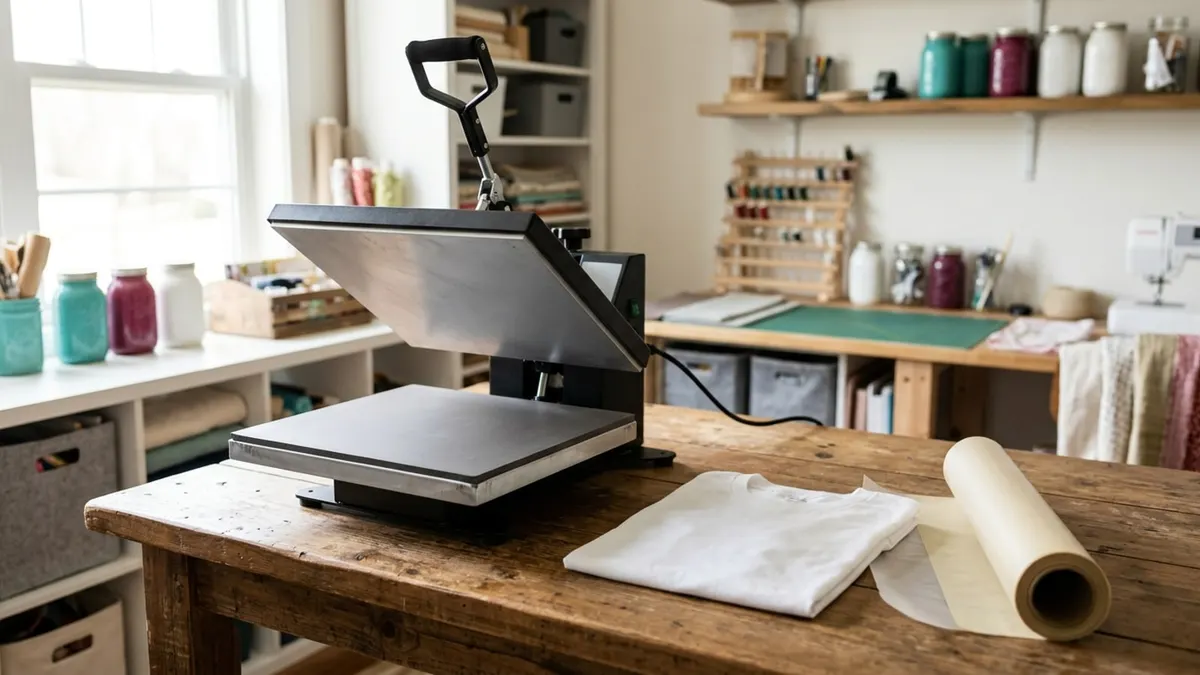
Affiliate disclosure: product links on this page go to Amazon, or to the maker's own store for brands that sell only direct. As an Amazon Associate we earn from qualifying purchases, at no extra cost to you; a link to a maker's store earns us nothing. No retailer or brand sees our picks before they are published or has any say in them. How we choose.
The Cricut AutoPress 2 (15 x 15) is the press we would buy for a home shirt business. It closes and opens itself, lets you set pressure as a number (45 to 220 lb in 5 lb steps, per Cricut), reaches 410°F, and its 15 x 15 inch plate covers an adult shirt front in one press. Amazon sells it directly.
If you want an auto press with more presets and a tilting screen, the HTVRONT Auto Heat Press 2 is the alternative. For a shop that presses all day, the Hotronix Auto Open Clam is built for it, but it needs its own 20 amp circuit. On a tight budget, a manual 15 x 15 swing-away or clamshell does the same job with more effort, and a handheld Cricut EasyPress SE covers small, occasional jobs.
Picks are based on the makers' spec pages and manuals, the transfer makers' application settings, and whether the press is in stock on Amazon US from the maker's own store or Amazon itself.
Our top picks at a glance
1. Best overall
Cricut AutoPress 2 (15 x 15)Platen: 15 x 15 in · Style: Auto open, slide-out tray · Max temp: 410°F · Pressure: 45 to 220 lb, 5 lb steps
2. Best auto-release alternative
HTVRONT Auto Heat Press 2 (15 x 15)Platen: 15 x 15 in · Style: Auto release · Max temp: 410°F (per the Amazon listing) · Pressure: 20 to 80 kg, 7 levels
3. Best for a production shop
Hotronix Auto Open Clam (16 x 16, 120V)Platen: 16 x 16 in · Style: Auto-open clamshell · Max temp: 430°F · Pressure: Over-the-center, digital readout
4. Best budget swing-away
HTVRONT 15 x 15 Swing-Away Heat PressPlaten: 15 x 15 in · Style: Swing-away, 180° · Max temp: 410°F (per the Amazon listing) · Pressure: Knob
5. Best budget clamshell
VEVOR 15 x 15 Slide-Out Clamshell Heat PressPlaten: 15 x 15 in · Style: Clamshell, pull-out drawer · Max temp: 480°F · Pressure: Knob
6. Best for small, occasional jobs
Cricut EasyPress SE (12 x 10)Platen: 12 x 10 in · Style: Handheld · Max temp: 400°F · Pressure: By hand
| Pick | Platen | Style | Max temp | Pressure | Buy |
|---|---|---|---|---|---|
| Cricut AutoPress 2 (15 x 15)Best overall | 15 x 15 in | Auto open, slide-out tray | 410°F | 45 to 220 lb, 5 lb steps | Amazon |
| HTVRONT Auto Heat Press 2 (15 x 15)Best auto-release alternative | 15 x 15 in | Auto release | 410°F (per the Amazon listing) | 20 to 80 kg, 7 levels | Amazon |
| Hotronix Auto Open Clam (16 x 16, 120V)Best for a production shop | 16 x 16 in | Auto-open clamshell | 430°F | Over-the-center, digital readout | Amazon |
| HTVRONT 15 x 15 Swing-Away Heat PressBest budget swing-away | 15 x 15 in | Swing-away, 180° | 410°F (per the Amazon listing) | Knob | Amazon |
| VEVOR 15 x 15 Slide-Out Clamshell Heat PressBest budget clamshell | 15 x 15 in | Clamshell, pull-out drawer | 480°F | Knob | Amazon |
| Cricut EasyPress SE (12 x 10)Best for small, occasional jobs | 12 x 10 in | Handheld | 400°F | By hand | Amazon |
Best overall
Cricut AutoPress 2 (15 x 15)
The easiest 15 x 15 press to run batch after batch: it presses and releases on its own and sets pressure in pounds, not by feel.
- Platen
- 15 x 15 in
- Style
- Auto open, slide-out tray
- Max temp
- 410°F
- Pressure
- 45 to 220 lb, 5 lb steps
Pros
- Pressure is set as a number from 45 to 220 lb, so a DTF transfer and a vinyl decal can each get the setting their maker asks for
- Auto Mode presses and releases hands-free and adjusts for items up to 1.8 in thick, per Cricut
- Four customizable presets on a movable Control Pod, or sent from the Cricut app over Bluetooth
Cons
- Tops out at 410°F, which rules out the few specialty transfers rated above that
- The app features need a Bluetooth phone, the Design Space app and an internet connection
- Cricut says it is heavy enough to need a dedicated space; the Amazon listing gives a footprint of about 21 by 16 inches
Most home presses ask you to judge pressure by how hard the handle is to pull down. The AutoPress 2 replaces that with a number: Cricut lists a range of 20 to 100 kg (45 to 220 lb), adjustable in 5 lb steps, and the press applies it on its own in Auto Mode, then lifts when the timer ends. That matters most for DTF transfers and thick items such as hoodies, where too little pressure is the usual cause of a transfer lifting at the edges.
The 15 x 15 inch (38.1 cm) plate is Cricut's largest. Temperature runs from 212°F to 410°F (100°C to 210°C), and the box includes the press, the Control Pod on a 3.5 ft cord and a 15 x 15 pressing mat. Cricut also makes a 12 x 12 AutoPress 2, but Cricut says that size uses a preset pressure of 110 lb rather than an adjustable range, so the 15 x 15 is the one to buy if you press DTF or thick garments.
Skip it if you need temperatures above 410°F or want a press that works with no app at all: the presets work from the Control Pod, but the interactive Heat Guide lives in Cricut's app. The listing gives a one-year limited warranty; Cricut's warranty page has the full terms.
Best auto-release alternative
HTVRONT Auto Heat Press 2 (15 x 15)
An auto-release 15 x 15 with seven pressure levels, eight presets and room for a hoodie, sold by HTVRONT's own Amazon store.
- Platen
- 15 x 15 in
- Style
- Auto release
- Max temp
- 410°F (per the Amazon listing)
- Pressure
- 20 to 80 kg, 7 levels
Pros
- Seven pressure levels from 20 to 80 kg (about 44 to 176 lb), per HTVRONT's own setup guide
- 4.5 cm (1.77 in) of heating height for hoodies and thicker blanks
- Four built-in and four custom presets, a timer from 1 to 999 seconds and a screen that tilts from 0° to 75°
Cons
- Pressure comes in seven steps rather than Cricut's 5 lb increments, and the top setting is lower
- HTVRONT's site lists several generations and bundles; check the listing says Auto Heat Press 2 before you buy
- Sold by HTVRONT's store on Amazon rather than by Amazon itself
HTVRONT's second-generation auto press raises the two things its first model was short on: pressure and height. Its setup guide gives adjustable pressure from 20 to 80 kg in seven levels and a 4.5 cm heating height, and the Amazon listing puts the top pressure at 170 lb and the top temperature at 410°F, reached in about five and a half minutes. You set time and temperature, press start, and the press closes, counts down, beeps and releases.
Where it beats the Cricut is presets and ergonomics: eight presets instead of four, and a screen that tilts through seven angles. Where it trails is pressure resolution and top pressure. If most of your work is vinyl and sublimation, that gap rarely matters; if you press a lot of DTF on heavy cotton, the Cricut's finer, higher pressure range is the safer bet for consistency.
Best for a production shop
Hotronix Auto Open Clam (16 x 16, 120V)
A made-in-USA auto-open clam with a lifetime heating element warranty, for a business pressing every day.
- Platen
- 16 x 16 in
- Style
- Auto-open clamshell
- Max temp
- 430°F
- Pressure
- Over-the-center, digital readout
Pros
- Warranty: lifetime on the heating element, 5 years on the frame, 2 years on the circuit board, 1 year on other parts
- Opens automatically at the end of the timer, which Hotronix says prevents over-application and scorching
- Interchangeable lower platens and a digital readout for time, temperature and pressure
Cons
- The operator's manual requires a fully dedicated 20 amp circuit at 120 volts, so many home outlets will not do
- Weighs 77 lb, per Hotronix
- Priced for businesses, many times the cost of the hobby presses here
Hotronix is the heat press arm of Stahls', and the Auto Open Clam is the press it builds for shops that run all day. The 16 x 16 model's operator's manual sets the temperature from 176°F to 430°F, and the press opens on its own when the time is up. The warranty is the strongest here by a wide margin: lifetime on the heating element, five years on the framework, two years on the circuit board and one year on other parts.
The catch is power and weight. The manual asks for a fully dedicated 20 amp circuit for 120 volt models and warns against running other high-draw equipment on the same circuit, and the press weighs 77 lb. Hotronix sells through distributors; on Amazon US it is listed by Stahls' own store. Buy it when pressing is your business, not your weekend.
Best budget swing-away
HTVRONT 15 x 15 Swing-Away Heat Press
A manual 15 x 15 swing-away that keeps the hot plate away from your hands while you lay out a design.
- Platen
- 15 x 15 in
- Style
- Swing-away, 180°
- Max temp
- 410°F (per the Amazon listing)
- Pressure
- Knob
Pros
- The top plate swings 180° clear of the lower platen, so you lay out transfers with no heat over your hands
- 1500 W and 104 to 410°F, per the listing
- Separate control panel on a 1 m cable and a 15-minute auto shutoff, per the listing
Cons
- Pressure is set with a knob and judged by feel
- A swing-away needs clear space beside it for the plate to swing into
- Figures come from the Amazon listing; HTVRONT's site lists many press models and we could not match this one to a spec page
A swing-away press lifts the heated plate and rotates it off to the side, leaving the lower platen open and cool to work on. That is the main reason to choose one over a clamshell: you can place several transfers or a layered design without leaning under a hot plate. This HTVRONT model is listed at 1500 W with a range of 104 to 410°F, a pressure knob, an auto shutoff after 15 minutes idle and a one-year warranty.
Everything here is manual: you close it, watch the timer and open it. For a few dozen shirts a week that is fine. Our clamshell, swing-away and draw press guide explains when the extra footprint is worth it.
Best budget clamshell
VEVOR 15 x 15 Slide-Out Clamshell Heat Press
The cheapest way into a full 15 x 15 plate, with a pull-out drawer that brings the lower platen out from under the heat.
- Platen
- 15 x 15 in
- Style
- Clamshell, pull-out drawer
- Max temp
- 480°F
- Pressure
- Knob
Pros
- VEVOR lists 1400 W, 32 to 480°F and a 0 to 999 second timer
- The pull-out drawer slides the lower platen out from under the hot plate for loading
- Sold by Amazon itself, which keeps returns simple
Cons
- Manual pressure by knob and feel
- VEVOR's page lists no warranty term, only optional paid protection plans
- The Amazon listing shows a different model code from VEVOR's page (1515QCG32 vs SJY-H15152M); check the box you receive is the slide-out version
A clamshell opens like a book, so it takes the least room of any press style, and the pull-out drawer on this VEVOR solves the clamshell's main annoyance: reaching under a hot plate to place a shirt. VEVOR's product page for the green 15 x 15 slide-out lists 1400 W, 32 to 480°F, a 0 to 999 second timer and 39.2 lb with accessories.
It is a sound first press for someone testing whether shirts sell. What you give up against the auto presses is consistency: pressure is whatever the knob and your arm make it, and there is no automatic release if you walk away. VEVOR's page shows no standard warranty term, so keep the receipt.
Best for small, occasional jobs
Cricut EasyPress SE (12 x 10)
A handheld 12 x 10 that stores in a drawer, for a few shirts or bags rather than a business.
- Platen
- 12 x 10 in
- Style
- Handheld
- Max temp
- 400°F
- Pressure
- By hand
Pros
- Heats to 400°F (205°C) with a ceramic-coated plate, per Cricut
- Insulated safety base and auto-off
- Small enough to store when you are not using it; Cricut also makes a 9 x 9
Cons
- No clamping pressure, which is why transfer makers give separate, often longer settings for handheld presses
- The 12 x 10 plate needs two presses for a full adult shirt front
- Not a press for DTF runs or heavy hoodies
The EasyPress SE is a heated plate with a handle: you hold it on the transfer and supply the pressure yourself. Cricut lists heat up to 400°F and compatibility with iron-on (HTV), Infusible Ink and sublimation products, and sells it on its own or with a mat. It replaces an iron for gifts and small batches, with even heat across the plate.
For selling, it runs out of road quickly. Transfer makers write separate settings for presses like this because the pressure is lower and less even: Siser, for example, gives EasyWeed 305°F for 10 to 15 seconds at medium pressure on a heat press and tells EasyPress users to add to that temperature. When you are pressing more than a handful of shirts a week, move up to a 15 x 15.
How we chose
A heat press for a shirt business has four jobs: cover the design in one press, hold the temperature the transfer maker asks for, apply pressure you can repeat, and plug into the circuit you have. We compared each press on its platen size, press style, temperature range, how pressure is set, and power, from the makers' pages and manuals. We left out presses whose listings did not match a model we could identify, and multi-attachment combo presses, which we cover in the tumbler and hat press guides.
What to look for in a heat press
Platen size
A 15 x 15 inch plate covers a full adult shirt front, a tote and most pillow covers in one press. Smaller plates (9 x 9, 12 x 10, 12 x 12) need a second press for large designs, and each extra press is a chance to double-heat or misalign. If you plan to press youth sizes and pockets as well, interchangeable lower platens, offered on presses like the Hotronix, make small items easier to load.
Press style
A clamshell opens like a book and needs the least space. A swing-away rotates the hot plate to the side so you can lay out a design with nothing hot above your hands. A draw press slides the lower platen out like a drawer. Auto presses like the Cricut and HTVRONT open on their own when the timer ends. Our press style guide covers the trade-offs in detail.
Pressure you can repeat
Transfer makers specify pressure as light, medium or firm, and the result depends on hitting it the same way every time. A knob-and-handle press relies on feel. The AutoPress 2 sets pressure in pounds, the HTVRONT in seven levels, and the Hotronix shows a digital pressure readout. If you press DTF transfers or thick hoodies, repeatable pressure is worth paying for.
Temperature and the transfer maker's settings
The right temperature is the one printed by the maker of the transfer, not the press. Siser, for example, gives its EasyWeed vinyl 305°F (150°C) for 10 to 15 seconds at medium pressure, with a 2 to 3 second pre-press of the garment. Every press here reaches well past that; the top of the range matters only for the specialty materials rated above 400°F. Our heat press settings chart collects the makers' settings by material.
Power and your circuit
Watts divided by volts gives amps. The hobby presses here list 1,400 to 1,500 W, which works out to about 11.7 to 12.5 amps on a 120 V outlet. That is most of a standard 15 amp circuit, so do not run a space heater, iron or second press on the same breaker. The Hotronix operator's manual asks for a fully dedicated 20 amp circuit for its 120 volt models. Check what else shares the circuit before you set up a press in a spare room.
Common mistakes
- Buying a small handheld press for a business. It works, but two presses per shirt and hand pressure slow every order.
- Trusting a generic temperature chart. Use the settings from the maker of the vinyl, film or blank you bought.
- Ignoring the model number. Budget presses are sold under many listings; match the model on the box to the one you researched.
- Forgetting the extras. Teflon or parchment cover sheets, a heat-resistant mat and, for DTF, the transfers themselves. Our HTV, DTF and screen printing comparison covers what each method needs.
Frequently asked questions
What size heat press is best for T-shirts?
A 15 x 15 inch press covers a full adult shirt front in one press, which is why it is the common size for shirt businesses. A 16 x 20 suits oversize prints and blankets, while 9 x 9 and 12 x 10 presses need two presses for a large design.
Is a heat press better than an iron for HTV?
A heat press holds an even temperature across the whole plate and applies steady pressure, which an iron cannot. Siser still gives home iron settings for EasyWeed, so an iron works for one-off projects, but a press is the tool for repeat orders.
Can I use a heat press for DTF transfers?
Yes. DTF transfers are applied with a heat press using the time, temperature and pressure the transfer or film maker specifies, often with firmer pressure than vinyl. Auto presses with set pressure, like the Cricut AutoPress 2, make those settings easier to repeat.
Do I need a dedicated circuit for a heat press?
A 1,400 to 1,500 W hobby press draws about 11.7 to 12.5 amps on 120 volts, most of a standard 15 amp circuit, so keep other heaters off that breaker. Commercial presses can need more: the Hotronix Auto Open Clam manual requires a fully dedicated 20 amp circuit for its 120 volt models.
Clamshell or swing-away: which is better?
A clamshell takes less space and is quicker to open and close. A swing-away moves the hot plate fully out of the way, which makes layered designs and thick items easier and keeps heat off your hands. Choose by your space and by how much layout work you do.
Is the Cricut AutoPress 2 worth it over a manual press?
If you press in batches, yes: it applies a set pressure from 45 to 220 lb, opens on its own and stores presets, which removes most of the variation between shirts. For a few shirts a month, a manual 15 x 15 does the same job for less money.
Sources
- Cricut AutoPress 2, 15 x 15, Cricut
- What is the difference between Cricut AutoPress 2 12 x 12 and Cricut AutoPress 2 15 x 15?, Cricut
- Cricut EasyPress SE, 12 in x 10 in, Cricut
- Auto Heat Press 2 Guide, HTVRONT
- Hotronix Auto Open Clam Heat Press, Hotronix
- Operator's Manual, Auto Open Series Clam/Hover Press, Stahls' Hotronix
- VEVOR Heat Press, 15 x 15 inch Digital Heat Press Machine, Slide Out, VEVOR
- EasyWeed application instructions, Siser
Cover image: Illustration: CraftsCall (AI-generated)
Related guides
Best Hat Presses for Caps and Trucker Hats (2026)
Six ways to press a cap, from an auto press with 176 lb of pressure to a pro press with a heated lower platen, compared on platens, heat and pressure.
Best Mug Presses for Sublimation and Infusible Ink (2026)
Five ways to press mugs, from Cricut's one-touch Mug Press to a dual-station press that does two 11 oz mugs at once.
Best Tumbler Heat Presses for Sublimation (2026)
Five ways to sublimate tumblers, from an auto press that sets its own pressure to an oven that does four cups at once, matched by cup size and diameter.