
HTV vs DTF vs Screen Printing: Which Shirt Method Fits Your Orders
Heat transfer vinyl, DTF and screen printing compared for a small shirt business: designs, order sizes, setup, curing and equipment, from the makers' instructions.
Affiliate disclosure: product links on this page go to Amazon, or to the maker's own store for brands that sell only direct. As an Amazon Associate we earn from qualifying purchases, at no extra cost to you; a link to a maker's store earns us nothing. No retailer or brand sees our picks before they are published or has any say in them. How we choose.
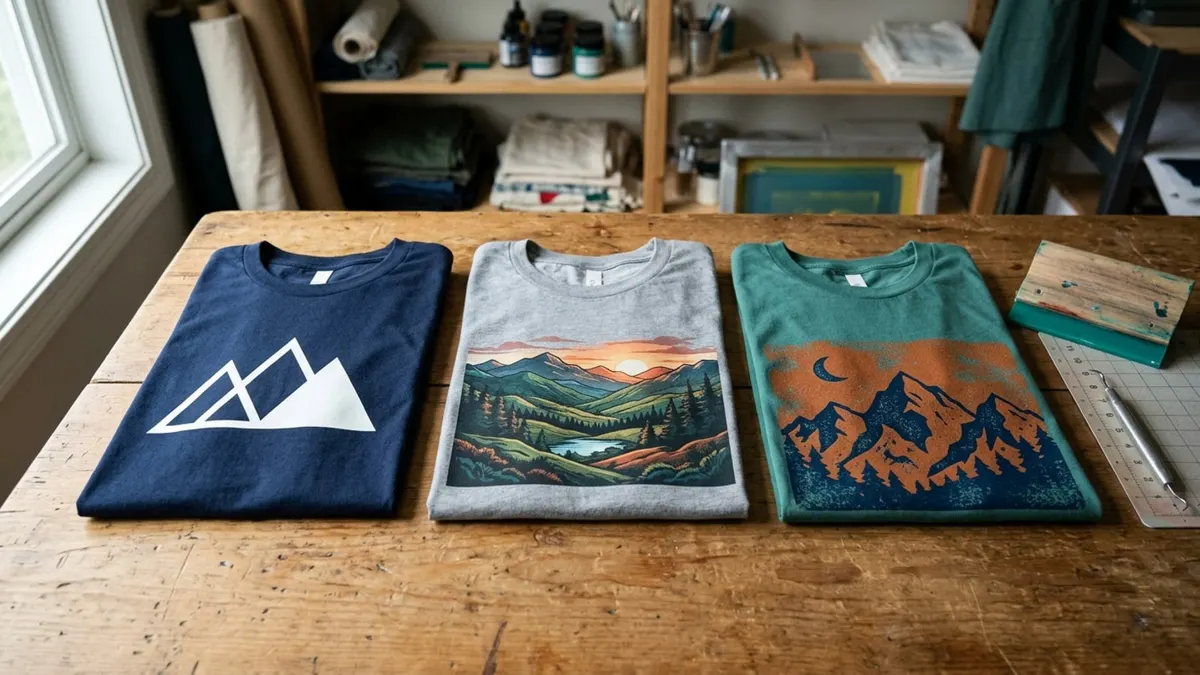
Use heat transfer vinyl (HTV) for simple one- to three-color designs and one-off or small orders: a cutter, vinyl and a heat press are all it takes. Use DTF for full-color designs, photos and dark garments in any quantity from one up, either printing your own or buying ready-made transfers. Use screen printing for larger runs of the same design, where the setup of each screen is spread over many shirts.
Most small shops end up using two of the three. The comparison below uses the makers' own instructions: Siser for vinyl, Stahls' for DTF transfers and Avient (Wilflex inks) and Speedball for screen printing.
The three methods at a glance
| HTV | DTF | Screen printing | |
|---|---|---|---|
| Best designs | Text, logos, 1 to 3 solid colors | Full color, gradients, photos | Bold designs with a few spot colors |
| Best order size | One-offs and small batches | One-offs to medium runs | Larger runs of one design |
| Garment colors | Any (vinyl comes in colors) | Any (white underbase) | Any, with an underbase on darks |
| Fabrics | Cotton, polyester, blends (EasyWeed per Siser) | Cotton and other fabrics (per transfer maker) | Cotton best; polyester needs low-cure ink |
| Setup per design | Cut and weed each design | Print, powder and cure, or order transfers | Burn a screen per color |
| Main equipment | Cutter, heat press | DTF printer and oven, heat press (or bought transfers) | Press, screens, exposure, dryer |
Heat transfer vinyl
HTV is colored vinyl with a heat-activated adhesive. A cutting machine cuts the design, you weed away the excess, and a heat press applies it. Siser's EasyWeed, for example, goes on at 305°F for 10 to 15 seconds at medium pressure, works on cotton, polyester, blends and leather, and Siser says to wait 24 hours before the first wash.
Its strengths are low cost of entry and no minimum: one shirt with a name on it is as easy as ten. Its limits are color and detail. Every color is a separate layer to cut, weed and press, and fine detail is slow to weed. See our vinyl cutter guide for machines.
DTF
DTF prints a full-color design with a white layer onto film, which is powdered, cured and pressed. Because the white is printed under the color, designs show on dark shirts, and there is no per-color setup: a photo costs the same to print as a logo of the same size. Stahls' instructions for its UltraColor MAX DTF transfers give 325°F on 100% cotton and 290°F on other fabrics, 12 to 15 seconds at medium pressure, peeled hot.
You can print DTF yourself or buy transfers. Stahls prices UltraColor MAX from 6 cents per square inch, down to as low as 4 cents with quantity, with a $0.35 minimum per piece, which makes buying transfers a practical way to offer full-color shirts with only a heat press. Our DTF start-up costs guide compares the two routes.
Screen printing
Screen printing pushes ink through a mesh screen, one screen per color. Making screens takes time (coating with emulsion, exposing, washing out), so the first shirt of a design costs the most and every additional shirt costs little. Kits like Speedball's Advanced All-In-One include the screen, emulsion and an LED exposure lamp to learn the process.
Curing is where screen printing goes wrong. Avient's Wilflex guide says both time and temperature are needed to fully cure plastisol ink, and recommends checking the ink film temperature with a thermoprobe. On polyester, Avient says dye migration starts once the fabric reaches 280°F and recommends low-cure inks. Our screen printing press guide covers presses and curing.
Which method for which order
| Order | Usually best | Why |
|---|---|---|
| One shirt with a name | HTV | No setup beyond cutting |
| Ten shirts with a full-color photo | DTF (printed or bought) | No per-color setup; any garment color |
| Ten team shirts, one color, different names | Screen print the logo, HTV the names | Each method where it is strongest |
| A large run of one two-color design | Screen printing | Screen setup spread over many shirts |
| Polyester performance shirts | HTV or DTF made for polyester, or sublimation on light colors | Avoids plastisol dye migration |
Start-up equipment
- All three: a heat press for HTV and DTF; screen printing needs a dryer or flash unit instead to cure ink. See our best heat press guide.
- HTV: a cutting machine, weeding tools and vinyl.
- DTF: either bought transfers, or a DTF printer, powder, film and an oven (see the DTF printer guide).
- Screen printing: a press, screens, emulsion, an exposure light, squeegees, ink and a dryer.
Shirts are not the only small-run product: buttons and pins sell alongside them at markets and events, and our button maker guide covers the presses. For polyester and drinkware, compare DTF and sublimation.
Frequently asked questions
Is DTF better than HTV?
For full-color designs and photos, yes, because DTF prints any number of colors in one transfer. For simple one-color text and logos, HTV is cheaper to start and has no printing or powder steps.
When is screen printing cheaper than DTF?
On larger runs of the same design. Screen printing has a fixed setup per color, then a low cost per shirt, while DTF costs about the same per transfer regardless of quantity. Stahls prices its DTF transfers from 6 cents per square inch, which is the figure to compare against.
Can I start a shirt business with just a heat press?
Yes. With a heat press you can apply bought DTF transfers or vinyl cut elsewhere. Stahls sells DTF transfers with no order minimum and a $0.35 minimum price per piece, which lets you test designs before buying a printer or cutter.
Which method lasts the longest?
All three last well when applied with the maker's settings and cured fully. Screen printing depends on proper curing; Avient says both time and temperature are needed to fully cure plastisol. For vinyl, Siser says to wait 24 hours before the first wash of EasyWeed.
What is the best method for dark shirts?
DTF, because it prints a white layer under the color. HTV also works on dark shirts since the vinyl is colored, and screen printing uses a white underbase on darks.
Sources
- EasyWeed application instructions, Siser
- UltraColor MAX DTF transfers, Stahls'
- Tips & Techniques: Ink Curing Tips, Avient (Wilflex)
- Printing Performance Wear Tips, Avient
- Advanced All-In-One Screen Printing Kit, Speedball
- Epson SureColor F1070 User's Guide, Epson
Cover image: Illustration: CraftsCall (AI-generated)
Related guides
Best Button Makers for Pins, Badges and Craft Fair Sales (2026)
Six button makers from a lifetime-warranty steel press to a budget three-size kit, plus the cut-size chart every button maker needs.
Best Screen Printing Presses for a Home Shirt Shop (2026)
Four presses and a starter kit for screen printing shirts at home, what colors and stations mean, and how to cure plastisol properly.
Best Vinyl Cutters for Making Shirts with HTV (2026)
Five cutters for HTV shirts compared on cut width, matless length, software and connectivity, from a compact Joy Xtra to a 24 inch roll cutter.