
DTF vs Sublimation: Which Printing Method Fits What You Sell
DTF vs sublimation for a small business: the fabrics and colors each prints on, how each feels and lasts, the equipment each needs, and which suits shirts or mugs.
Affiliate disclosure: product links on this page go to Amazon, or to the maker's own store for brands that sell only direct. As an Amazon Associate we earn from qualifying purchases, at no extra cost to you; a link to a maker's store earns us nothing. No retailer or brand sees our picks before they are published or has any say in them. How we choose.
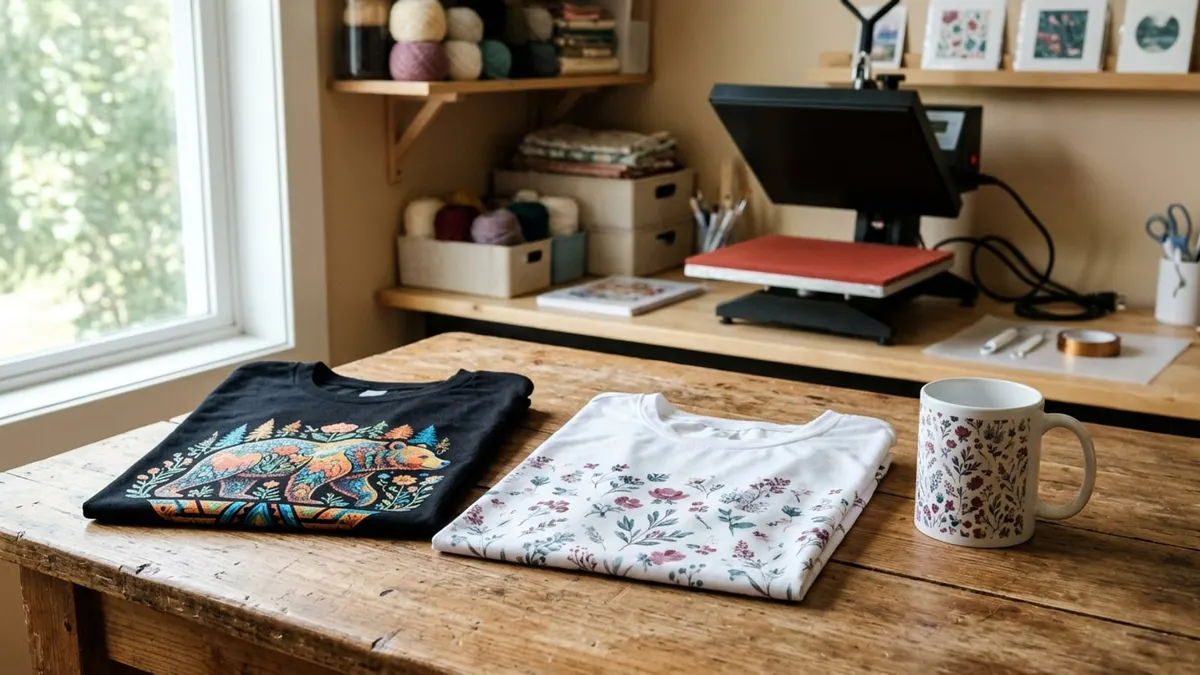
Choose DTF if you sell shirts in any color and fabric, especially cotton and dark garments: DTF prints color plus white ink on film, so the design shows on black cotton. Choose sublimation if you sell polyester apparel in light colors and hard goods like mugs and tumblers: the dye bonds into polyester or a polymer coating, which gives a soft, permanent print but only on the right blanks. Many shops end up with both, because they cover different products.
The rules below come from the makers: Epson's DTF guidance in its SureColor F1070 user's guide, Stahls' DTF transfer instructions, and Sawgrass's sublimation materials.
The short answer
| DTF | Sublimation | |
|---|---|---|
| Fabrics | Cotton, polyester, blends and more (per transfer maker) | Polyester; the higher the polyester content, the better (Sawgrass) |
| Garment colors | Any, including black (white ink underbase) | White and light colors |
| Hard goods (mugs, tumblers) | Not the usual method (see UV DTF) | Yes, on polymer-coated blanks |
| How the print sits | A thin printed film bonded to the surface | Dye inside the polyester fibers or coating |
| Extra steps | Apply powder, cure, then press | Print, tape to blank, press |
| Printer type | DTF printer with white ink | Sublimation printer (4 colors) |
How each method works
DTF (direct to film)
A DTF printer prints your design in color plus a layer of white ink onto clear film. Hot-melt adhesive powder goes on the wet ink, is cured, and the finished transfer is pressed onto the garment. Epson's guide spells out why the white matters: the powder will not stick to the film unless white ink is printed. That white layer is also what lets a DTF print show on black and dark shirts.
Sublimation
A sublimation printer prints dye ink onto transfer paper. Under heat and pressure the dye turns into a gas and bonds into polyester fibers or a polymer coating, as Sawgrass describes it. There is no white ink and nothing sitting on top of the fabric, so the print feels like the shirt itself, but it only works on polyester and coated items, and it shows best on white and light colors.
Fabrics and colors
This is the deciding difference for most shirt sellers. DTF transfers go onto cotton, polyester and blends: Stahls' UltraColor MAX DTF instructions give one setting for 100% cotton (325°F) and another for all other fabrics (290°F), 12 to 15 seconds at medium pressure. Sublimation needs polyester; Sawgrass notes that the higher the polyester content, the brighter and more durable the result. If your customers want classic cotton tees in black, DTF is the method.
Sawgrass does offer a way around sublimation's limits: its VersiFlex ink system, which it says extends printing to cotton and other natural fabrics using VersiFlex Light paper. It is a newer, Sawgrass-only route; most sellers who want cotton choose DTF.
Mugs, tumblers and hard goods
Sublimation is the standard for drinkware: coated mugs and tumblers take the dye, and Sawgrass's settings chart gives ceramic mugs 350 to 400°F for 150 to 210 seconds at medium pressure. DTF transfers are made for fabric. For tumblers in any color, the related UV DTF method prints stickers that apply by hand; see our UV DTF printer guide.
Equipment and work per piece
A sublimation setup is a 4-color sublimation printer, paper, heat tape and a press. A DTF setup is a DTF printer with white ink, film, powder, a curing oven or shaker, and a press. DTF has more steps and more maintenance: white ink settles and can clog, which is why DTF printers add white ink circulation and automatic cleaning, and Epson recommends a room at 59 to 77°F and 40 to 60% relative humidity. Epson also says to apply powder away from the printer and to wear a mask and protective eyewear while powdering.
| Item | DTF | Sublimation |
|---|---|---|
| Printer | DTF printer (white ink) | Sublimation printer |
| Media | PET film | Sublimation paper |
| Extra consumables | Hot-melt powder | Heat tape |
| Curing | Oven or shaker oven | None (the press does it) |
| Press | Flat or hat press | Flat, mug or tumbler press |
Cost of entry
Sublimation is the cheaper way in: Epson lists its SureColor F170 sublimation printer at an MSRP of $399. DTF printers cost more, and a complete DTF kit with an oven costs several times as much; Epson's hybrid SureColor F1070, which prints both direct to garment and to film, has an MSRP of $4,995. If you want to sell DTF shirts without buying a printer, ordering ready-made DTF transfers and pressing them yourself is a common middle path.
Which to choose
| You mainly sell... | Choose |
|---|---|
| Cotton tees and hoodies, any color | DTF |
| Polyester sportswear and light shirts | Sublimation |
| Mugs, tumblers, coasters, slates | Sublimation |
| A mix of cotton shirts and drinkware | Both, or sublimation plus bought-in DTF transfers |
| Small runs of simple one-color designs | Heat transfer vinyl may be enough |
Ready to buy? See our best DTF printer and best sublimation printer guides, and for vinyl and screen printing, the HTV, DTF and screen printing comparison.
Frequently asked questions
Can sublimation print on black shirts?
Not on its own. Sublimation has no white ink and dyes polyester fibers, so it shows on white and light colors. For black or dark shirts, DTF prints a white underbase that makes the design visible.
Can DTF be used on mugs and tumblers?
Standard DTF transfers are made for fabric. Drinkware is usually decorated by sublimation on coated blanks, or with UV DTF stickers, a related method that prints adhesive transfers for hard surfaces.
Which lasts longer, DTF or sublimation?
Both are durable when applied with the maker's settings. Sublimation dye becomes part of the polyester or coating, so there is nothing on the surface to wear; DTF is a printed film bonded to the fabric. Follow the transfer maker's wash instructions.
Is DTF or sublimation cheaper to start?
Sublimation. Epson's purpose-built SureColor F170 has an MSRP of $399, while DTF needs a white-ink printer, powder and a curing oven, which costs several times more. Buying ready-made DTF transfers avoids the printer cost.
Do I need a different heat press for DTF and sublimation?
No. The same flat heat press works for both, at the settings each maker gives. Sublimation on mugs and tumblers needs a mug or tumbler press, or a sublimation oven.
Sources
- Epson SureColor F1070 User's Guide, Epson
- UltraColor MAX DTF transfers, Stahls'
- Sublimation Printing Glossary for the Print Shop, Sawgrass
- VersiFlex vs Sublijet UHD: Which Sawgrass Ink Should You Use?, Sawgrass
- Sublimation Heat Press Settings, Quick Reference Guide, Sawgrass
- SureColor F170 Dye-Sublimation Printer, Epson
- SureColor F1070 DTG and DTFilm Standard Edition Printer, Epson
Cover image: Illustration: CraftsCall (AI-generated)
Related guides
Best DTF Printers for a Small Shirt Business (2026)
Four DTF setups from a 13 inch desktop kit to an automated print-to-bake line, compared on print width, printheads, curing and warranty.
Best Sublimation Printers for Shirts, Mugs and Tumblers (2026)
Five purpose-built sublimation printers compared on print size, ink system, software and warranty, and why a converted EcoTank is a risk.
Best UV DTF Printers for Cup Wraps and Stickers (2026)
How UV DTF differs from regular DTF, and five machines for sticker transfers and direct printing on hard goods.